

Steel facade and modular scaffolding is one of the most valuable pieces of equipment a company can have– a well-chosen system can work for years, serving successive contracts without losing its functionality.
At some point, however, a natural stage arrives. Some sets have been through many seasons, and the owner begins to think not only about the next job, but about the full life cycle of the equipment.
This is a good time to look at scaffolding not as a cost, but as an asset that can be wisely developed.
Conscious renovation and organized recycling are a real opportunity to generate additional financial, organizational, and image value.
Table of Contents
The late phase of scaffolding use – signs that it is time to organize the equipment
After several years of intensive work, the history of the project is visible on the components. Signs of wear and tear are natural, but they can be a good basis for planning the next steps: which scaffolding remains “on the front line,” which is worth renovating, and which should be converted into raw material.
The most common observations are:
- Local corrosion, scratches and abrasions, minor deformations of profiles, signs of overload on steel and wooden platforms,
- differences in technical condition between batches – some sets are almost textbook perfect, while others are clearly more worn out.
A well-planned inventory and technical inspection of scaffolding allow these observations to be turned into a concrete plan – which elements remain in current use, which are sent for renovation, and which should be withdrawn and redirected for recycling.
This gives you order in the warehouse, clear information for your teams, and a solid basis for making investment decisions.
Scaffolding renovation – maximizing the potential of your equipment
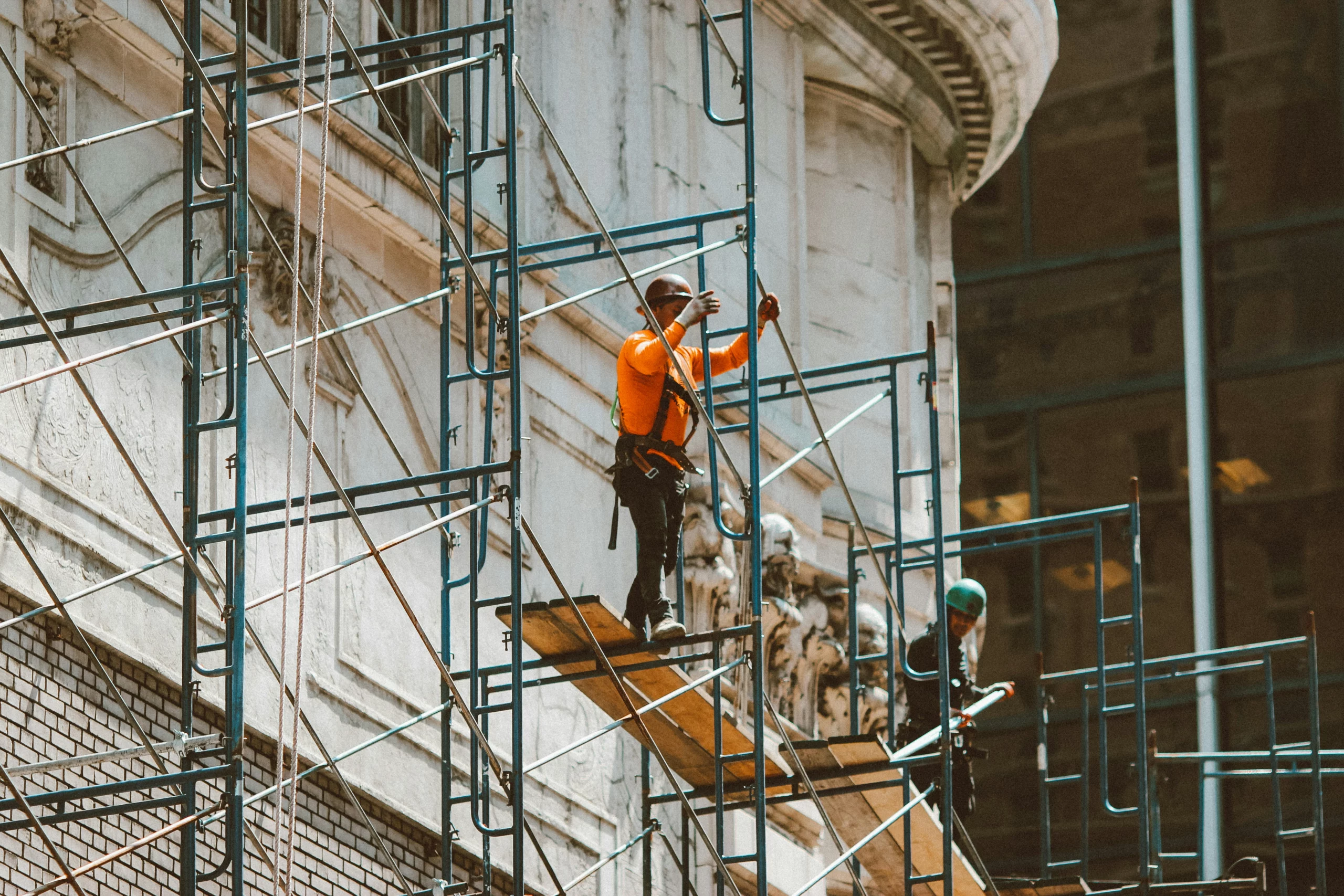
Scaffolding renovation is a way to get the most out of what you already have in your company. Instead of immediately replacing entire sets with new equipment, you can consciously renovate some of the elements and restore their full utility value.
In practice, the process involves cleaning and removing corrosion, straightening acceptable deformations, reapplying anti-corrosion protection, and replacing small components such as pins, wedges, and latches.
Finally, the dimensions and technical condition are verified. Only those components that actually meet the requirements are returned to further work – the rest are sent for recycling.
The benefits of this approach are quite specific:
- Technical – you work with proven components that are ready for further assembly.
- Financial – you reduce one-off expenses for new sets and take advantage of the potential of what is already in the company.
- Organizational – you can better plan renovations and purchases instead of reacting only when there are emergency equipment shortages.
- Ecological and image-related – you show that your company really uses the circular economy, and doesn’t just talk about it.
For many contractors, renovation is becoming a stable part of their strategy. Some of the scaffolding is gradually being renovated, and new purchases can be spread out over time, without the risk of equipment shortages on construction sites.
Scaffolding recycling – a tidy end to the cycle
There will always be a certain percentage of components that do not make sense to renovate, either technically or economically. This is a natural stage. The key is to ensure that these components do not turn into a chaotic pile of scrap metal behind the warehouse, but rather a planned stream of raw materials.
Sending steel and aluminum components for material recycling allows you to recover some of the value directly through the sale of scrap metal and, indirectly, frees up space and tidies up the storage area.
From an environmental point of view, you gain an additional argument. The material from your scaffolding returns to circulation as input for new products, instead of ending up in a landfill.
The same applies to wooden components – even if they do not return to work at height, they can be used in other ways, in accordance with local technological capabilities.
All in all, this means that you squeeze virtually all the potential out of your long-lasting equipment: first in operation, then in renovation, and finally in recycling.
Benefits for the company and the environment
When scaffolding renovation and recycling are treated as a permanent part of equipment management rather than a one-off action, they begin to contribute to the company’s bottom line.
Over time, you build a clear picture of how much equipment you actually have in working order, which parts are worth renovating as planned, and where it is more profitable to invest in a new system.
At the same time, you strengthen your position in the area of sustainable development. You can clearly show that you not only care about safety when working at height, but also consciously use raw materials, reduce waste, and treat scaffolding as a valuable asset that is worth managing professionally.
Summary
After years of intensive use, scaffolding does not have to be a problem that needs to be stored away somewhere.
It can become a source of added value—renovated components continue to be used on contracts, and those that cannot be salvaged are fed into the raw materials cycle.
In practice, scaffolding renovation and recycling is a very simple way to combine three goals at once—a stable supply of equipment for construction sites, better investment economics, and a responsible approach to the environment—without revolutionizing the organization of work.


